
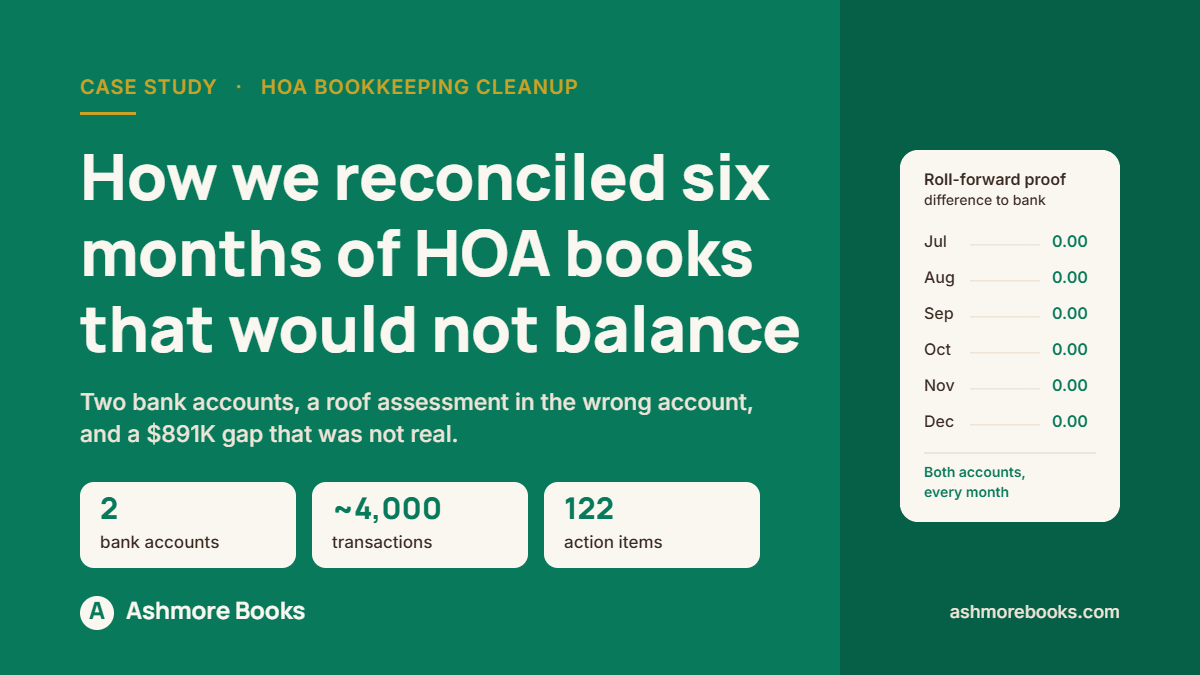
A homeowners association came to Ashmore Books with two bank accounts that had not reconciled since June, a “$891,000 uncleared” figure on the QuickBooks reconciliation screen, and a board that needed year-end financials. This is how the HOA bookkeeping cleanup actually went, what we found, and the method we now use for every association.
The situation: an HOA with two bank accounts and no reconciliation
The association has around 250 units. Every owner pays monthly dues, and in 2025 the board also levied a special assessment for a roof replacement project, collected month by month into a separate reserve account. Money moved through two bank accounts: an operating checking account for dues and expenses, and a money market account for the roof assessment.
Collections came in three ways: an ACH draft on the 15th for dues, a second ACH batch for the roof assessment, and a steady flow of paper checks and money orders deposited by the office. About 240 receipts a month, on top of vendor checks, payroll and transfers between the two accounts.
By the time the file reached us, QuickBooks Online had not been reconciled for six months. The bank feed had been disconnected. The reconciliation screen showed a wall of uncleared transactions with a total that looked like a nine-hundred-thousand-dollar hole. The board had been working through a spreadsheet of notes trying to explain the differences, and a volunteer had started making corrections directly in QuickBooks, which fixed some things and created others.
The scope was clear: reconcile both accounts for July through December, do not force anything, do not mass-delete, and give the board a list of exactly what needs to change and why.
Why HOA books get this messy
HOA accounting has a few traits that make it easier to break than a normal small business:
- Two or more bank accounts with money crossing between them. Roof assessment ACH batches settled into the operating account and were swept to the reserve account days later. If the receipts are recorded in the reserve account but the transfer is never entered, both accounts are wrong by the same amount, and the totals still look plausible.
- Hundreds of small receipts from the same people every month. One dues check for $468 can be $318 dues plus $150 roof assessment. If the office deposits it into checking but the bookkeeper records the roof part in the reserve account, cash is right in total and wrong in both accounts.
- Returned payments. A bounced ACH draft shows up on the bank statement as a debit days after the batch. Most HOA files record the batch and never the return, so the homeowner shows as paid and the bank does not agree.
- Duplicate customer records. One unit ends up as “Smith, John”, “Smith (Roof), John” and “Smith, J & M”. Invoices land on one record and payments on another, and the A/R aging fills with offsetting balances.
- Well-meaning corrections. Each person who touches the file fixes the symptom in front of them: a receipt moved, a duplicate re-entered, an invoice back-dated to absorb a payment. Six months later nobody can say what the original entry was.
What we found in the HOA’s QuickBooks file
Over six months, across roughly 4,000 transactions, the differences came from five repeating patterns:
- Roof assessment money in the wrong account. Five ACH batches settled into checking and were swept to the reserve account. The receipts were recorded three different ways across the year, and in December the same 45 homeowner receipts existed in both accounts at once. One sweep transfer of $21,100 was missing entirely.
- Dues checks deposited with the roof deposit, and roof checks with the dues deposit. The office bundled whatever was on the desk. QuickBooks recorded receipts by type of income instead of by the account the cash went into. Eleven dues checks in one November deposit alone.
- Returned ACH drafts not recorded. Six bounced payments across the period, none reversed. In two cases the receipt had been deleted instead, which fixes the bank and erases the fact that the owner never paid.
- Duplicate entries. A batch of nine vendor checks entered twice, once in each bank account. Individual receipts entered twice under slightly different names. A $4,000 roof pay-off invoiced on the dues record and paid on the roof record, leaving a $4,000 receivable that did not exist.
- Month-end items missing. Bank service charges, payroll processor fees, interest on the reserve account, and two checks written on the reserve account’s own check stock that were never entered at all.
The famous $891,000 turned out to be a report artifact. The real register balance at the start of the period was under $100,000 with nine outstanding checks. The number came from a corrupted print of the reconciliation screen where every row repeated four to sixteen times.
How we do an HOA bank reconciliation cleanup
1. One month at a time, one account at a time, from source documents
For each month we rebuilt the bank statement from the statement itself: every deposit, every ACH batch, every check, every fee. Then we rebuilt what QuickBooks had. The difference between the two, line by line, became the action list.
2. Deposit slips, not deposit totals
A $2,943 deposit is not reconciled until the eight checks on the slip are matched to eight receipts in QuickBooks with the right homeowner, check number and amount. We read every slip image from the bank statement. This is where most of the wrong-account and duplicate items surfaced.
3. ACH batches line by line
The bank’s transmittal file lists every homeowner drafted. We matched all 170-odd names to QuickBooks receipts each month, which caught the returns, the double drafts, the zero-amount template rows that make counts disagree, and the homeowners drafted under a bank account name that does not match the QuickBooks customer.
4. A roll-forward proof for each month
Opening register balance, plus corrected receipts, less corrected disbursements, equals bank balance less outstanding checks. If the proof does not go to zero, we are not done. Every month ended at zero, with the outstanding check list attached.
5. Nothing changed in QuickBooks without a written reason
We delivered a workpaper per month: what is wrong, the evidence (statement page, slip, batch line), the exact QuickBooks action, and a priority. The association’s volunteer posted the entries with a memo on each one. When she sent us the updated general ledger, we re-ran the proof against it and produced a short list of what was still open.
6. Then the receivables
With the cash right, we pulled the A/R aging as of year end and the invoice list, and tied the homeowner ledgers: payments sitting unapplied next to open invoices, duplicate customer records, back-dated invoices, late fees charged to owners who had actually paid, and the small group of genuinely delinquent units the board needed to decide on.
What the board received
- Both bank accounts reconciled to the statement for every month from July to December, with a roll-forward proof and an outstanding check list for each.
- A single action log across the period: 122 items, each with evidence and the QuickBooks fix, filtered down to 25 still open after the first round of postings.
- A receivables review: the year-end A/R of $37,000 was overstated on both sides, with $15,000 of open invoices matched by unapplied payments on the same owners and a short list of units for the board’s collection decision.
- A one-page list of the five patterns that caused the problem, with the process change for each, so the office stops creating the same differences next year.
What it cost, and what it saved
The engagement was a fixed fee agreed up front. No hourly surprises, no scope creep because the file was worse than expected. The board got clean year-end financials for the annual meeting and the tax return, a reserve account balance they could trust for the roof project, and homeowner statements that matched what people had actually paid.
Signs your association needs a bookkeeping cleanup
The signs are usually the same: the reconciliation has not been done in months, the treasurer keeps a side spreadsheet, homeowners dispute their statements, and the reserve account balance in QuickBooks does not match the bank. None of that is unusual, and none of it needs a forced adjustment to fix.
Ashmore Books does HOA and condo association cleanup and catch-up bookkeeping on a fixed fee, remotely, in QuickBooks Online, Xero and the other platforms associations use. We start with a free review of the file so you know what the cleanup involves before you commit, or you can book a call to talk it through first.
Frequently asked questions about HOA bookkeeping cleanup
How long does an HOA bookkeeping cleanup take?
For a six-month backlog on two bank accounts with a few hundred owners, expect two to four weeks from receiving the bank statements to delivering the reconciled books. The biggest variable is how quickly the association can supply statements, deposit slip images and ACH batch reports.
What documents does an HOA need to provide for a cleanup?
Bank statements with check and deposit images for every account, the ACH transmittal or batch report for each draft, the current QuickBooks (or other software) access, and any notes the treasurer or board has kept. A general ledger export and an A/R aging as of the period end help a great deal.
Should an HOA record roof or special assessment payments in a separate bank account?
Yes, if the money is physically held in a separate account, and the QuickBooks entry should follow the cash. Record each receipt in the bank account it was actually deposited to, and record any sweep between accounts as a transfer. Recording by type of income instead of by bank account is the single most common cause of HOA reconciliation problems.
What happens to a homeowner’s account when an ACH payment bounces?
The original payment should stay recorded and a return entry should be posted on the date the bank reversed it, so the homeowner’s invoice shows as unpaid again and the bank reconciles. Deleting the original payment makes the bank agree but hides the bounced payment from the owner’s history.
Can the cleanup be done without disturbing the current month’s bookkeeping?
Yes. Every change is listed with its evidence and posted with a memo, month by month, and each month is proved back to the bank before moving on. Current-month work continues as normal.
Details in this article have been generalized to protect the association’s privacy.