
Ask yourself three quick questions.
- Does your accountant only categorize transactions and file your tax return?
- Has your CPA ever sat down and walked you through your financials?
- Has anyone explained what your numbers mean, in plain language?
If the answer to the last two is no, you are not alone. For most small businesses, accounting stops at compliance. The books get closed, the return gets filed, and nobody asks why the margin moved.
That gap is where money quietly leaks out. This is a real case study of what a financial review found in a business that was, by every outward sign, doing fine.
What we found in the first few months
We took over the accounting for a business that had been running for more than ten years. Healthy sales. Healthy margins. The owner had never really looked at the financials, and honestly, why would he? Everything felt fine.
We came in because the previous accountant retired. Within the first few months of cleanup and review in QuickBooks Online, here is what surfaced.
1. Suppliers raised prices. The business never raised its own.
Cost of goods had been creeping up for a couple of years. Vendor invoices told the story clearly once they were mapped by month. Selling prices had barely moved.
The business was absorbing every supplier increase out of its own pocket. Nobody had flagged it, because nobody was comparing this year’s cost per unit to last year’s.
2. Sales were growing. Productivity was not.
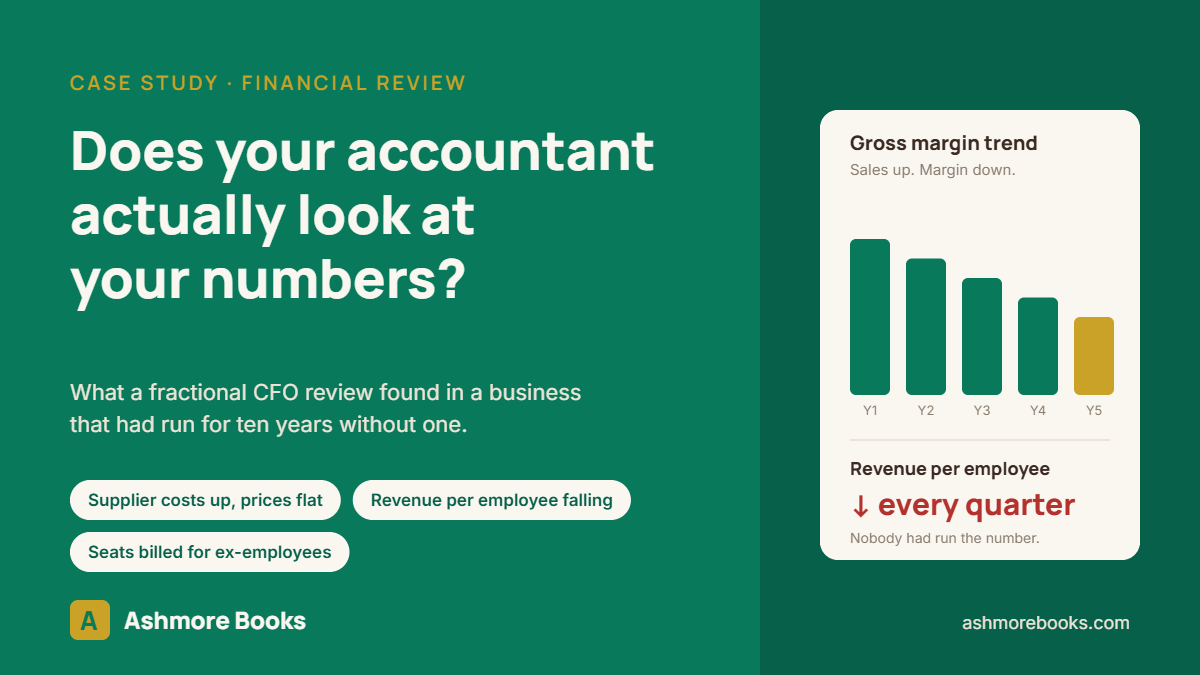
Top line revenue looked great. Gross profit margin was shrinking.
Headcount had grown alongside sales, which sounds reasonable until you look at revenue per employee. That number had been falling steadily, quarter after quarter. The business was buying growth with payroll instead of earning it with efficiency.
Revenue per employee is one of the simplest metrics in existence, and one of the least reviewed. It takes a clean payroll file and a clean P&L to see it, and most businesses have neither.
3. They were on a QuickBooks plan they did not need.
The business was paying for a higher tier QuickBooks Online subscription. Their actual usage fit a lower tier.
Small on its own. But it points to something bigger: nobody had reviewed the software stack in years.
4. They were paying for seats and subscriptions for people who had left.
This was the one that stung. Several per seat subscriptions were still active for employees who had left the company, some more than a year earlier. Their ADP records showed the terminations. The subscription billing did not reflect them.
Nobody had reconciled the two. Offboarding was handled as an HR task, not a financial one, so the charges just kept renewing month after month.
Did any of this need advanced accounting?
No. Notice what these findings have in common. Not one of them needed a complex technical analysis. They needed someone to look at the file, compare one period against another, and ask a question when something moved in the wrong direction.
That is not tax work. That is not bookkeeping in the data entry sense. That is financial review, and it is exactly the layer most small businesses are missing. It is also why books that match the bank can still be wrong.
Where does the review layer come from?
A good remote accounting partner should be doing more than closing the month. Accurate books are the starting point, not the finished product. What the owner needs after that is someone looking at the trend, catching what changed, and saying so before it becomes a pattern.
When that work is done by someone senior, it is usually called fractional CFO support. It does not need a full time hire, and it does not need to be local. Everything in the case study above was handled remotely, from cloud accounting files and payroll reports, without a single in person meeting.
Why does this get missed?
It is rarely negligence. It is usually scope.
Most accounting engagements are priced and staffed for compliance: categorize, reconcile, close, file. Analysis was never part of the deal, so it never happens. The business does not know to ask for it, and the accountant does not volunteer it.
The cost of that silence compounds. A margin slipping two points a year does not announce itself. It just shows up five years later as a business that works twice as hard for the same profit.
Does this sound familiar?
If you are reading this and realizing you have never had your own financials explained to you, that is the signal. Not a crisis, not a fraud problem, just a review layer that was never there.
Ashmore Books works as a remote accounting and tax partner for US small businesses. That means clean books in QuickBooks Online through monthly accounting, payroll coordination alongside ADP and similar platforms, US tax returns prepared by an Enrolled Agent, and a fractional CFO style review that tells you what your numbers actually mean.
If nobody has walked you through your financials yet, start with a free Books X-Ray. We review your file read-only and send written findings, including what your numbers are saying, before you commit to anything.
Frequently asked questions
Does my accountant review my financials, or just file my taxes?
Most small business accounting engagements are scoped for compliance only: categorize, reconcile, close, and file. Financial review, meaning trend analysis and margin questions, is usually not included unless it is specifically part of the agreement. If your accountant has never walked you through your numbers, it is likely outside their scope.
What is a fractional CFO review?
A fractional CFO review is a senior-level look at your financials after the books are closed. It compares periods, tracks margins, revenue per employee, and cost trends, and flags what changed and why. It does not require a full time hire and can be done fully remotely from cloud accounting and payroll data.
What does a financial review usually find?
Common findings include supplier cost increases that were never passed on, falling revenue per employee, software subscriptions on the wrong tier, and recurring charges for former employees. None of these require advanced analysis. They require someone comparing one period against another and asking questions.