
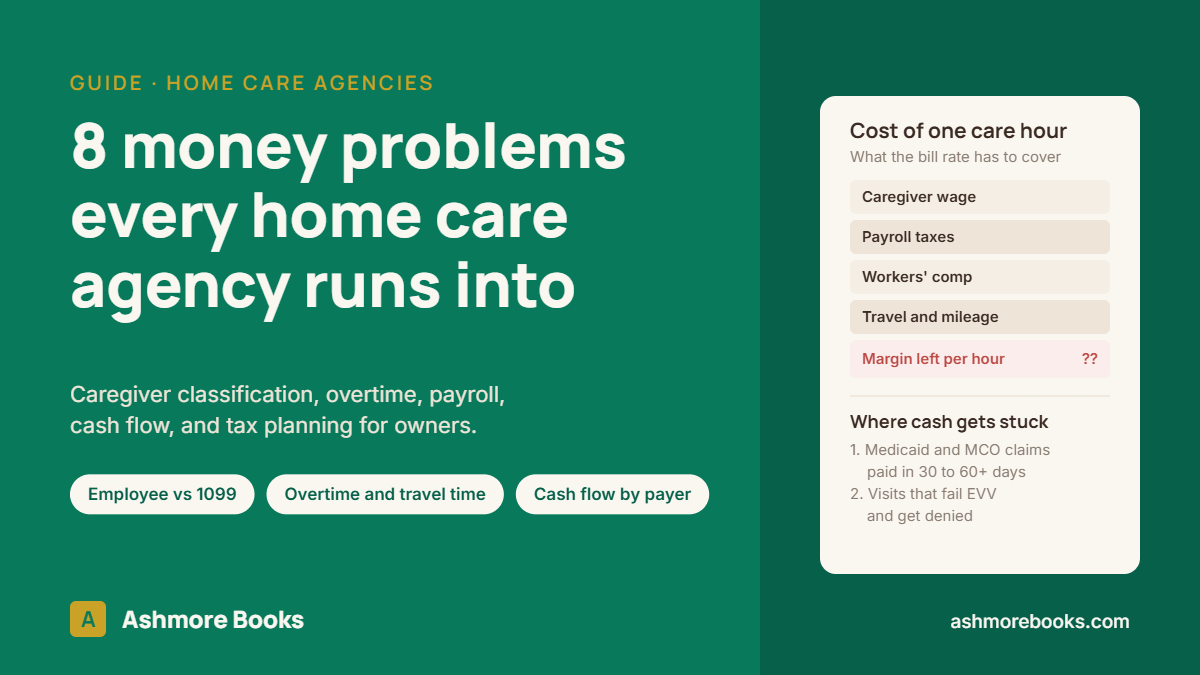
Home care agency accounting is harder than most small business bookkeeping because almost every dollar runs through payroll, and the money coming in arrives slower than the money going out. Owners of non-medical and home health agencies are dealing with dozens of caregivers, several payers, and state rules that change the answer to simple questions like “Is this person an employee?”
If you run a home care agency, these are the eight financial problems that come up most often, and what clean books and good planning do about each one.
1. Are my caregivers employees or independent contractors?
In most home care agencies, caregivers are employees. If your agency sets the schedule, assigns clients, follows a care plan, provides training, and controls how the work is done, the IRS common-law test points to employment.
Paying caregivers on a 1099 to save payroll taxes is one of the most expensive mistakes an agency can make. A misclassification finding can bring back payroll taxes, penalties, interest, unpaid overtime, and unemployment and workers’ compensation assessments, often for several years at once.
Some roles can be genuine contractors, such as an outside marketing firm, an IT consultant, or a professional who serves many agencies under their own business. The test is the relationship, not the job title.
A registry or referral model, where the agency matches caregivers with families and the family directs the work, is treated differently. That model has its own rules and should be set up deliberately, not assumed.
New Jersey callout: New Jersey applies the stricter ABC test for wage, unemployment, and disability purposes. A worker is presumed to be an employee unless all three parts are met, and one part requires the work to be outside the usual course of your business. Caregiving is the usual course of a home care agency’s business, so contractor treatment for caregivers is very hard to support in New Jersey. Several other states use a similar test.
2. Are we paying overtime and travel time correctly?
Under the federal Home Care Rule that took effect in 2015, third-party agencies cannot claim the companionship or live-in exemptions. That means agency-employed caregivers are generally owed minimum wage and overtime for hours over 40 in a workweek.
The Department of Labor proposed bringing those exemptions back in July 2025 and paused its own enforcement, but at the time of writing no final rule has been issued, the existing rule is still in effect, and caregivers can still bring private claims for unpaid overtime. State overtime laws apply regardless of what happens federally. Until a final rule takes effect, the safer course is to keep paying overtime.
Two areas cause most of the problems:
- Travel time between clients. Time a caregiver spends driving from one client’s home to another during the workday is generally hours worked. The commute to the first client and home from the last one usually is not. If travel between clients is not recorded, overtime is understated.
- Caregivers with multiple assignments. Hours across all clients in the same workweek count together for overtime, even if they are billed to different payers.
Some states add daily overtime or higher minimum wages for home care workers. Your payroll setup should reflect the rules where your caregivers actually work.
3. Does payroll actually tie to the books?
Your payroll provider runs payroll and files the returns. But the provider does not check whether your books agree with payroll, and that gap is where errors hide.
Every month, the accounting side should confirm that:
- Gross wages in the books match the payroll register.
- Payroll tax liabilities clear to zero after each deposit.
- Quarterly Forms 941 and state unemployment filings match what is recorded.
- W-2 totals agree with the four quarterly 941s at year end.
- Mileage reimbursements, advances, and garnishments are recorded in the right accounts, not buried in wages.
When these do not match, it is usually a sign of a missed filing, a duplicate payment, or a liability that was never paid. Catching it monthly costs far less than finding it during a payroll tax notice.
4. Why is cash tight when the business is growing?
Growth is often what breaks cash flow in home care. Payroll goes out every week or two, but reimbursements come in on each payer’s timeline:
- Medicaid and managed care plans can take 30 to 60 days or longer, and denied claims take longer still.
- VA and long-term care insurance have their own authorization and billing cycles.
- Private-pay clients are faster but can fall behind without follow-up.
Every new client adds payroll immediately and cash later. An agency adding caregivers quickly can run short even while showing a profit on paper.
What helps:
- Accounts receivable aging by payer, reviewed monthly, so slow payers and denied claims surface early.
- A 13-week cash forecast that lines up payroll dates against expected collections.
- EVV reconciliation. Medicaid-funded visits must match Electronic Visit Verification records. When visit data, billing, and payroll hours disagree, claims get denied and cash stalls.
5. What is our real margin per hour of care?
Many agency owners know their bill rate and their pay rate but not their true margin. The real cost of one hour of care includes:
- Caregiver wage
- Employer payroll taxes (Social Security, Medicare, federal and state unemployment)
- Workers’ compensation insurance, often one of the largest expenses in home care
- Overtime and travel time
- Mileage reimbursement
- Training, onboarding, and turnover costs
When the books are set up to show revenue and labor cost by payer, you can see which payers and service lines make money and which ones quietly lose it. That is the information you need before renegotiating rates or taking on a new contract.
6. Is our entity structure and owner pay set up for taxes?
Many agencies start as a single-member LLC and never revisit the structure. As profit grows, planning becomes worth real money:
- S corporation election. Can reduce self-employment tax, but only with a reasonable salary for the owner based on the role and the market. Setting that salary too low is a common audit issue.
- Multiple locations or service lines. Separate entities can limit liability and make each location’s profitability visible, but they add filings and must be kept clean.
- Retirement plans. A well-designed plan can shift meaningful income from taxable to tax-deferred for the owner while helping retain key staff.
- Accountable plan for mileage. Caregivers who drive between clients can be reimbursed tax-free when the plan is documented properly.
If your agency is a franchise or part of a multi-location group, see our franchise accounting page for how location-level reporting, royalties, and acquisitions are handled. For owner pay and entity questions, see tax planning.
7. Can our financials stand up to a state, payer, or lender request?
Home care agencies get asked for financial information more than most small businesses. Licensing renewals, Medicaid program cost reporting, managed care contracts, lenders, and buyers may all want financial statements or cost data.
If the books are behind or unreconciled, every one of these requests becomes a scramble. Monthly closed books, reconciled payroll, and a clean balance sheet mean the numbers are ready when someone asks, and support for your responses when a state agency or payer comes back with questions. If the file is already months behind, catch-up bookkeeping is the first step.
8. Who answers our accounting questions during the month?
Agency owners field questions all day about schedules, clients, and staff. Accounting questions, like how to record a large insurance payment or whether a new hire can be paid as a contractor, should not wait for year end.
Good support means a team that knows your file, answers by email or message within one business day, and flags issues before they turn into tax or payroll problems.
How Ashmore Books helps home care agencies
Ashmore Books is an Enrolled Agent-led firm that handles both accounting and tax planning for home care agencies, so the team that keeps your books is the same team planning your taxes.
- Monthly accounting with payroll-to-books reconciliation and AR aging by payer
- Cleanup and catch-up bookkeeping for agencies months or years behind
- Tax planning covering entity structure, reasonable compensation, and retirement plans
- CFO services for cash forecasting, margin analysis, and multi-location reporting
- Ongoing support by email and message, with a reply within one business day
Ashmore Books works alongside your payroll provider. It does not replace it, and it keeps an eye on the numbers the provider produces.
Not sure where your books stand? Request a free Books X-Ray. Your file is reviewed on a read-only basis and you receive written findings, a recommended scope, and a fixed quote.
Frequently asked questions
Can home care caregivers be paid as 1099 contractors?
Usually not. When an agency sets schedules, assigns clients, and directs the care, caregivers are employees under the IRS test. States like New Jersey use an even stricter ABC test. Misclassification can lead to back taxes, penalties, and unpaid overtime claims.
Do home care agencies have to pay caregivers overtime?
Yes, in most cases. Under the federal Home Care Rule, third-party home care agencies cannot use the companionship or live-in exemptions, so caregivers are generally owed overtime for hours over 40 in a workweek. The Department of Labor has proposed changing this, but no final rule has been issued at the time of writing, and state overtime laws apply either way.
Is travel time between clients paid time for caregivers?
Generally yes. Time spent traveling from one client to another during the workday counts as hours worked under federal wage rules and must be included when calculating overtime. The commute to the first client and home from the last one usually does not count.
Why does my home care agency run short on cash even when it is profitable?
Payroll is paid weekly or biweekly, while Medicaid, managed care, and insurance payers can take 30 to 60 days or more. Growth widens that gap. AR tracking by payer and a 13-week cash forecast help you plan around it.
Does Ashmore Books file payroll for home care agencies?
No. Your payroll provider files payroll returns. As part of monthly accounting, Ashmore Books reconciles payroll to the books, checks that tax liabilities clear, and flags differences before they become notices.