
Be honest for a second.
When was the last time you emailed your CPA and got an answer the same day? Or the same week?
For a lot of creators, it goes like this. You have a question. Maybe a brand sent you a 1099 you didn’t expect, or you’re about to buy a new camera and wonder if it’s deductible. You send an email. Nothing. You call. Voicemail. Five days later a two-line reply shows up, and by then you’ve either forgotten what you asked or already made the decision on your own.
If that sounds familiar, this article is for you. Below is what a good remote accountant for content creators should actually do for you, plus clear answers to the questions creators ask us most.
Yes, we are a remote accountant for content creators, and we say it upfront
Ashmore Books is a fully remote accounting and tax team. There’s no office for you to drive to, and we don’t pretend otherwise.
Here’s why that works for creators in particular:
- You already run your business online. Your income comes from YouTube, TikTok, Twitch, Patreon, and brand deals. Your records live in dashboards, PayPal, Stripe, and your bank app. Nothing about that needs a desk across from you.
- We work with creators in all 50 states. Where you live doesn’t limit who you can hire.
- Everything happens where you already are. Email, video calls, and shared files. You don’t lose half a day to an appointment.
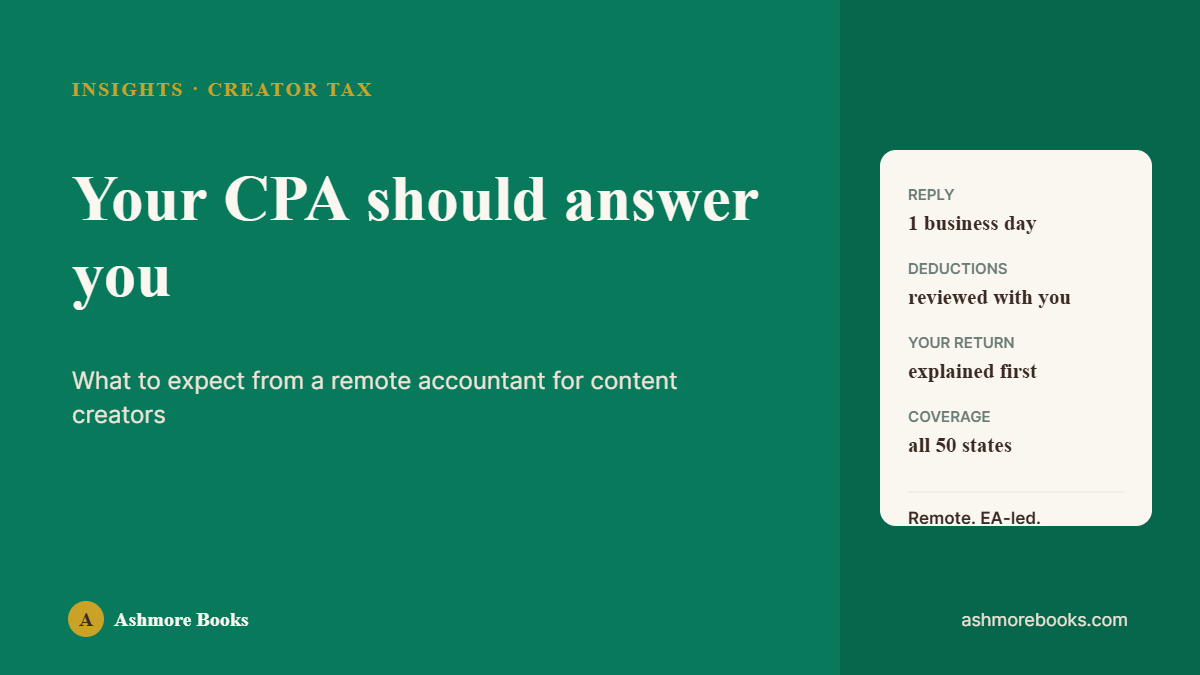
- Remote doesn’t mean hard to reach. It’s actually the opposite. We reply to every client within one business day. That’s a promise we built the firm around, not a nice-to-have.
The real question isn’t whether your accountant is in the same city. It’s whether they answer you when you need them.
Five questions to ask about your current CPA
Take a minute with these. No right or wrong answers, just an honest check.
1. Do they reply when you reach out?
A tax question usually comes up right before a decision. If the answer arrives after the decision, it’s useless.
2. Did they ask you about your deductions, or just take whatever you sent?
Many preparers work only with what’s in front of them. If you didn’t mention your home studio, your editor, or the flight to that brand shoot, it may never have made it onto your return.
3. Did they explain what they claimed on your return?
You’re signing that return. You should know what’s on it, why your tax went up or down, and what to do differently next year.
4. Do they ever talk to you about your expenses?
Not just “send me your receipts.” An actual conversation: what’s deductible, what’s personal, what’s in a gray area, and how to keep proof for each one.
5. Do you only hear from them in March and April?
If your accountant disappears for ten months, you’re doing tax planning alone, which usually means no one is doing it.
If you answered “no” to two or more, you’re not being difficult. You’re just not being served.
How working with Ashmore Books is different
Here’s what you can count on when you work with us:
- A reply within one business day. Every client, every time. Simple questions get answered in the reply. Bigger ones get a call on the calendar.
- A deductions conversation before we file. We go through your year with you, category by category, and ask about the things creators often forget: equipment, software, editors and contractors, home office, phone and internet, travel for content, props, and platform fees.
- Your return, explained in plain English. With our tax preparation, before you sign, we walk you through what we claimed, what changed from last year, and why.
- Books and taxes handled by the same team. Your tax return is built from books we’ve already reconciled, so the numbers on your 1099s, your platform reports, and your return actually agree. (If your 1099-K looks bigger than what you received, here’s why that happens.)
- Planning during the year, not just filing after it. Buying equipment, hiring an editor, forming an LLC, thinking about a move: we talk it through before you commit, when the answer can still save you money.
- An Enrolled Agent-led team. Enrolled Agents are federally licensed tax practitioners with unlimited rights to represent taxpayers before the IRS. Tax is not a side service here. It’s the core of what we do.
What makes us a good fit for creators
Plenty of firms can file a Schedule C. What’s harder to find is a team that understands how creator money actually moves.
Your platform shows one number. Your bank shows another after fees and holds. Your 1099 shows a third. Most creator books go wrong right there, and most tax problems start there too. We reconcile all three, every platform, so nothing is double-counted and nothing slips through.
We also take on the files other bookkeepers turn down. A year of mixed personal and business spending, unreconciled PayPal and Stripe dumps, or no books at all? That’s normal for us. See how our QuickBooks cleanup works.
Questions creators ask us
I did my own bookkeeping, but I want someone to review it. Can you do that?
Yes, and it’s one of the smartest things you can do before filing. We review what you’ve done, check that your accounts reconcile to your bank and platform statements, flag anything miscategorized, and point out gaps. You keep the work you’ve done, and you find out where it needs fixing before it lands on a tax return. Our free Books X-Ray is a good place to start.
I’ve done my own books, but I’m not sure I captured all my deductions. Can you check?
Absolutely. Self-prepared books usually record what was paid, but they don’t always catch what’s deductible. Common misses for creators include the business share of phone and internet, a home office or studio, software subscriptions, equipment bought on a personal card, and travel for shoots or events. We go through your spending with you and ask the questions a spreadsheet can’t.
I’m planning to buy some equipment for my business. Can you tell me the tax benefit before I buy?
Yes, and this is the right time to ask. The timing and the way you buy can change the result.
- Under current law, most new and used equipment, like cameras, lenses, lighting, and computers, can often be written off in full in the year it’s placed in service, through Section 179 or 100% bonus depreciation. The 2025 tax law made 100% bonus depreciation permanent for property acquired after January 19, 2025.
- “Placed in service” matters. Equipment bought in December but not set up until January may count for next year, not this one.
- A full write-off isn’t always the best choice. If this is a low-income year, spreading the deduction out may save more over time.
- Vehicles have special rules and limits, and business use has to be tracked.
- If you sell the equipment later, some of that deduction can come back as income.
We run the numbers on your actual income, so you know the real after-tax cost before you spend. Learn more about our tax planning.
I’m a creator and I can live anywhere. Which state is best for taxes?
This is one of the few real tax advantages creators have. Your income doesn’t depend on living in a particular city.
As of 2026, nine states have no tax on wage or earned income: Alaska, Florida, Nevada, New Hampshire, South Dakota, Tennessee, Texas, Washington, and Wyoming. But “no income tax” isn’t the whole story:
- Some of those states tax businesses in other ways. Texas has a franchise tax, Washington has a business and occupation tax on gross receipts, and Tennessee taxes certain entities like LLCs. Depending on your setup, these may or may not apply to you.
- Other costs matter too. Property taxes, sales taxes, and cost of living can offset the income tax savings.
- Moving is about more than a new address. States look at your domicile, meaning where your life actually is: where you live most of the year, where your home is, where your car is registered, where you vote, where your doctors and family are.
- High-tax states often look closely at people who leave. California and New York, for example, are known for reviewing residency changes. Keeping a second home or spending too many days back in the old state can mean you’re still treated as a resident.
- The year you move usually means two part-year returns. Income has to be split correctly between the two states.
We can compare your options using your real income and walk you through what a clean move looks like, so the savings actually hold up.
Which business structure is best for me: sole proprietor, LLC, or S-Corp?
It depends on how much you earn and where you live. Here’s the simple version:
- Sole proprietor: the default. No setup, income goes on Schedule C, and your profit is subject to self-employment tax on top of income tax.
- Single-member LLC: gives you a legal separation between you and the business. For federal tax, it’s usually treated the same as a sole proprietor unless you elect otherwise. Some states charge a yearly LLC tax or fee, like California’s $800 annual LLC tax.
- S-Corp election: once your profit is consistently high, an LLC can elect to be taxed as an S-Corp. You pay yourself a reasonable salary through payroll, and the remaining profit isn’t subject to self-employment tax. In exchange, you take on payroll, a separate business return, and more bookkeeping.
- Partnership: if you create with a co-host or partner, a multi-member LLC is usually taxed as a partnership, and the agreement between you matters a lot.
The S-Corp decision in particular is a numbers call. We model it with your actual income, your state, and your salary, and show you what you’d save after the extra costs, before you file anything. Not sure how much to set aside in the meantime? This guide helps.
You’re remote. How do we actually work together?
By email and video call, on your schedule. You share access or documents, we do the work, and you get a reply within one business day whenever you reach out. Nothing depends on getting to an office, which is one less thing on your plate.
Do you work with creators outside my state?
Yes. We work with U.S. creators in all 50 states and prepare federal returns along with the state returns you need, including part-year returns for the year you move.
Your accountant should be the easiest call you make
You spend your days making content, answering comments, and managing brand deals. The last thing you need is an accountant you have to chase.
If you want a team that answers, asks about your deductions, explains your return, and helps you plan before big decisions, let’s talk.
Start with a free Books X-Ray. We review your books, tell you what we find in writing, and give you a fixed quote. No pressure, no obligation. Prefer to jump straight in? Request a custom quote and we’ll reply within one business day.
This article is general information, not tax advice for your specific situation. Tax rules depend on your facts, so talk to a qualified tax professional before acting.