
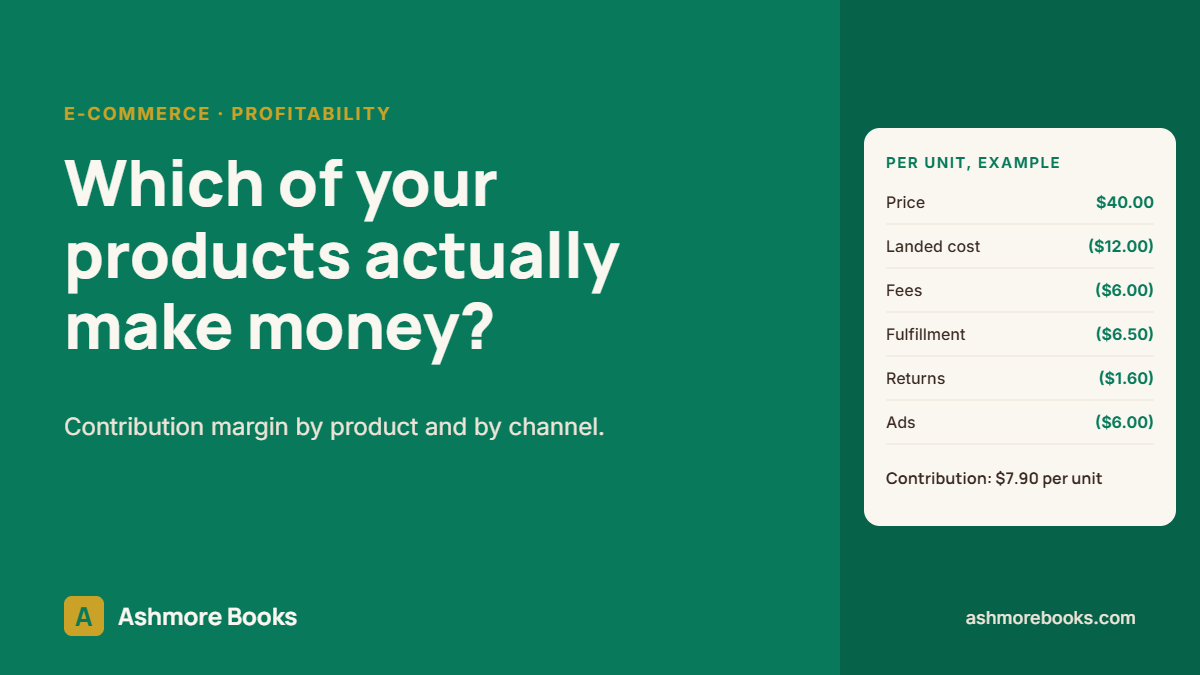
A store can grow every month and still lose money on its best-known product. The gross margin on the Profit and Loss averages everything together, so one product quietly losing money hides behind two that carry the business. Product-level profitability separates them, and it is usually the most useful number an e-commerce owner is not looking at.
In Profitable on paper, broke in the bank, we saw how much cash inventory can tie up. This article answers the next question: which products actually deserve that cash?
The short answer
Product profit is contribution margin: the selling price minus landed product cost, marketplace and payment fees, fulfillment and shipping, the cost of returns, and the advertising spent to sell it. Calculate it per product, or per product family, and per channel, then rank the results.
Why gross margin is not enough
- Gross margin usually includes only product cost. Fees, fulfillment, returns, and ad spend often sit further down the Profit and Loss as operating expenses.
- On a marketplace, those costs can add up to more than the product itself.
- Averages hide losers. A 45% store-wide gross margin can include a product that loses money on every unit once fees and ads are counted.
The formula, per unit
- Selling price, after discounts
- minus landed cost: supplier price plus freight, duties, tariffs, broker fees, and prep
- minus fees: marketplace referral fees or payment processing
- minus fulfillment and shipping: FBA fees, 3PL pick and pack, postage
- minus returns: return rate times the average loss per return
- minus advertising: campaign spend for the product divided by units sold
- equals contribution margin, the amount each unit adds toward overhead and profit
A worked example
The numbers below are illustrative, not client figures. The same $40 product is sold on Amazon through FBA and on Shopify with a 3PL.
| Per unit | Amazon (FBA) | Shopify |
|---|---|---|
| Selling price | $40.00 | $40.00 |
| Landed cost | ($12.00) | ($12.00) |
| Marketplace or payment fees | ($6.00) | ($1.50) |
| Fulfillment and shipping | ($6.50) | ($7.00) |
| Returns (8% return rate) | ($1.60) | ($1.60) |
| Advertising per unit | ($6.00) | ($12.00) |
| Contribution margin | $7.90 (about 20%) | $5.90 (about 15%) |
Two things stand out. Amazon’s fees look high, but lower ad cost per unit makes it the better channel for this product. And the margin is thin in both places. If a tariff increase pushes landed cost from $12.00 to $15.00, the Amazon margin drops to $4.90, about 12%, and the Shopify margin to $2.90, about 7%. Scaling ad spend on this product without a price change would grow sales and shrink profit at the same time.
Where the numbers come from
- Landed cost: supplier invoices plus freight bills and customs entries, allocated to units by quantity, weight, or value.
- Fees and fulfillment: Amazon settlement reports, Shopify payout detail, and 3PL invoices. See how to record Amazon settlements and why Shopify deposits never match sales.
- Returns: platform return reports, including items that cannot be resold.
- Advertising: Amazon Ads, Meta, and Google campaign reports mapped to the products they promote.
This only works if the books record gross sales and keep fees in separate accounts. Books that record net deposits cannot produce these numbers, because the fees were never recorded in the first place.
What to do with the answer
- Rank products by total contribution dollars and by margin percentage. Both matter.
- For thin or negative products: raise the price, renegotiate with the supplier, change fulfillment, cut the ad budget, or discontinue.
- For strong products: plan inventory cash early, especially before the fourth quarter.
- Recalculate whenever landed cost or platform fees change, not just once a year.
A monthly product profitability schedule is part of what our CFO services deliver for e-commerce brands, and our financial review walks owners through what it means. It starts with clean books, which is where e-commerce accounting comes in. To see where your file stands, request a free Books X-Ray.
Frequently asked questions
What is contribution margin for an e-commerce product?
Selling price minus every cost that rises with each sale: landed product cost, marketplace or payment fees, fulfillment and shipping, the cost of returns, and advertising. It shows what each unit contributes toward fixed costs and profit.
What is landed cost?
The full cost of getting a product to where it can be sold: the supplier price plus freight, customs duties and tariffs, broker fees, and prep or inspection costs. Using only the supplier price overstates margin, sometimes by a wide amount for imported goods.
How do tariffs affect product margins?
Tariffs are part of landed cost, so every increase lowers contribution margin unless prices rise. The books should add duties and tariffs to inventory cost when goods are received, so the higher cost reaches cost of goods sold as units sell.
Should advertising be included in product profitability?
Yes, if the goal is to know whether a product is worth selling. Allocate campaign spend to the products it promotes. Brand-level ads that cannot be traced can be spread by sales or shown separately.
Can I see product profitability in QuickBooks Online?
Partly. QuickBooks Online can track product cost and sales by item, but marketplace fees, fulfillment, returns, and ad spend usually need to be combined from platform reports. A monthly profitability schedule built from clean books is the common approach.
E-commerce books and tax series
Read more about e-commerce bookkeeping and tax
- Your Books Show Net Payouts. Here Is What You Are Missing.
- Why Shopify Sales Never Match Your Bank Deposits (and How the Books Should Record Them)
- How to Record Amazon Settlement Reports in QuickBooks Online
- Amazon FBA Sales Tax Nexus: What Inventory in Amazon Warehouses Means for You
- 7 Bookkeeping Mistakes That Make Online Sellers Overpay Tax
- Profitable on Paper, Broke in the Bank: The E-commerce Cash Flow Trap
- Which Products Actually Make Money? Product Profitability for E-commerce Brands (you are reading this)
Selling online and want the books done this way? See e-commerce accounting and tax.