
Most Amazon sellers believe sales tax is Amazon’s problem. For orders placed on Amazon, it mostly is. But Fulfillment by Amazon spreads your inventory across warehouses in many states, and inventory sitting in a state can create obligations that Amazon does not handle for you. Here is what that means in practice.
In how to record Amazon settlement reports in QuickBooks Online, marketplace facilitator tax showed up as a settlement line that nets to zero. That handles the tax on Amazon orders. This article looks at what it does not cover.
The short answer
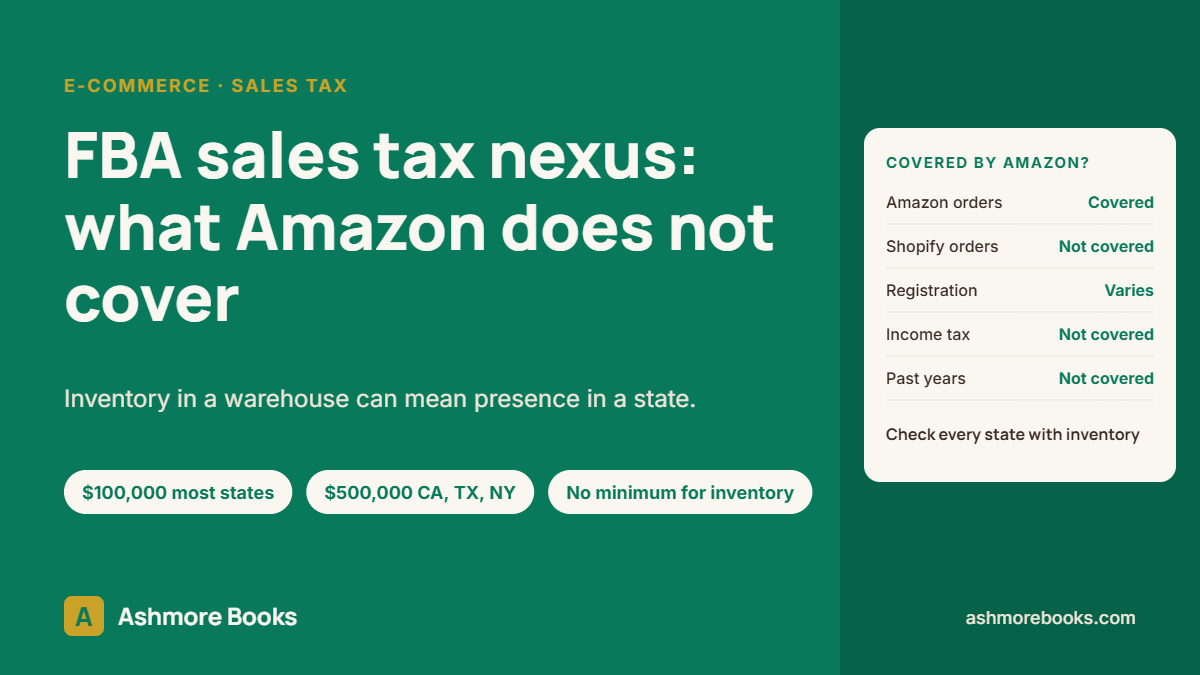
Amazon collects and remits sales tax on Amazon orders in every state that has a sales tax, under marketplace facilitator laws. That covers the tax on those orders. It does not automatically cover state registration, the sales you make through your own website or other channels into the same states, or the state income and franchise taxes that inventory in a state can trigger.
Two ways to have nexus in a state
- Physical nexus. Property, people, or inventory in a state. Most states treat FBA inventory stored in a fulfillment center as your property in that state. There is no dollar threshold, so a small amount of inventory can count.
- Economic nexus. Selling above a state’s threshold. Most states use $100,000 of sales into the state in the current or prior year. California, Texas, and New York use $500,000. Some states also count 200 or more transactions, though that test is being dropped, including by Illinois from January 1, 2026 and Kentucky from August 1, 2026. States also differ on whether marketplace sales count toward the threshold.
What marketplace facilitator laws cover, and what they do not
Covered: tax on orders placed on Amazon and shipped to customers in those states. Amazon calculates it, collects it from the buyer, and files it with the state.
Not automatically covered:
- Your other channels. If FBA inventory gives you nexus in a state, taxable sales you make there through Shopify, your own website, wholesale, or another marketplace may require you to collect and remit tax yourself.
- Registration. Some states exempt sellers whose only sales there are marketplace sales. Others expect a seller with inventory in the state to register and file returns, even when those returns show only marketplace sales.
- State income and franchise tax. Sales tax and income tax are separate systems. Federal law (Public Law 86-272) protects sellers whose only activity in a state is soliciting orders for goods, but storing inventory there generally goes beyond that protection, so some states may expect an income or franchise tax filing.
- Past years. Amazon’s collection only started when each state’s law took effect, and it never covered sales made outside Amazon.
How to find out where your inventory has been
- Pull Seller Central’s inventory reports, such as the Inventory Ledger, which list inventory movements by fulfillment center. Each fulfillment center code maps to a state.
- Build a simple table: state, the date inventory first arrived, and your non-Amazon sales into that state by year.
- Compare each state against its current rules for registration, marketplace-only sellers, and economic thresholds.
If you find past exposure
- Quantify it before acting: taxable sales by state and by year, from every channel outside Amazon.
- Do not simply register and start filing. The registration date can raise questions about the years before it.
- Many states offer voluntary disclosure agreements that typically limit the look-back period to a few years and waive most penalties. The order of steps matters, so get advice before contacting a state.
- Going forward, track sales by state every month so crossing a threshold is a decision, not a surprise.
Where the books come in
Sales tax only stays under control when the books separate it from revenue. That means sales tax collected recorded as a liability, marketplace facilitator tax recorded as a pass-through that nets to zero (see how to record Amazon settlements in QuickBooks Online), and sales by state reviewed monthly. It is a standard part of our e-commerce accounting work. If you are not sure where your file stands, request a free Books X-Ray.
General information, not tax advice for your situation. State rules vary and change often, so confirm current rules for each state before acting.
Sales tax left inside income is also one of the ways sellers overpay income tax. The full list is in 7 bookkeeping mistakes that make online sellers overpay tax.
Frequently asked questions
Does Amazon collect sales tax for FBA sellers?
Yes, for orders placed on Amazon. Under marketplace facilitator laws in every state with a sales tax, Amazon calculates, collects, and remits tax on Amazon orders. It does not collect tax on sales you make through your own website or other channels.
Does FBA inventory create sales tax nexus?
Generally yes. Most states treat inventory stored in a fulfillment center as physical presence, which has no dollar threshold. What that requires, registration, filing, or nothing beyond Amazon’s collection, depends on the state and on whether you also sell outside Amazon.
If Amazon collects the tax, do I still need to register?
Sometimes. Some states exempt sellers whose only sales there are marketplace sales. Others expect a seller with inventory in the state to register and file returns, even if those returns show only marketplace sales. Check each state where inventory has been stored.
Do I owe sales tax on Shopify orders shipped to states where Amazon holds my inventory?
Possibly. If FBA inventory gives you nexus in a state, taxable sales you make there through your own store may require you to collect and remit tax yourself, because Amazon only covers orders placed on Amazon.
What if I should have been collecting sales tax in past years?
Quantify the exposure by state and year first. Many states offer voluntary disclosure agreements that limit the look-back period and waive most penalties. Get advice before registering, because the order of steps can change what you owe.
E-commerce books and tax series
Read more about e-commerce bookkeeping and tax
- Your Books Show Net Payouts. Here Is What You Are Missing.
- Why Shopify Sales Never Match Your Bank Deposits (and How the Books Should Record Them)
- How to Record Amazon Settlement Reports in QuickBooks Online
- Amazon FBA Sales Tax Nexus: What Inventory in Amazon Warehouses Means for You (you are reading this)
- 7 Bookkeeping Mistakes That Make Online Sellers Overpay Tax
- Profitable on Paper, Broke in the Bank: The E-commerce Cash Flow Trap
- Which Products Actually Make Money? Product Profitability for E-commerce Brands
Selling online and want the books done this way? See e-commerce accounting and tax.