
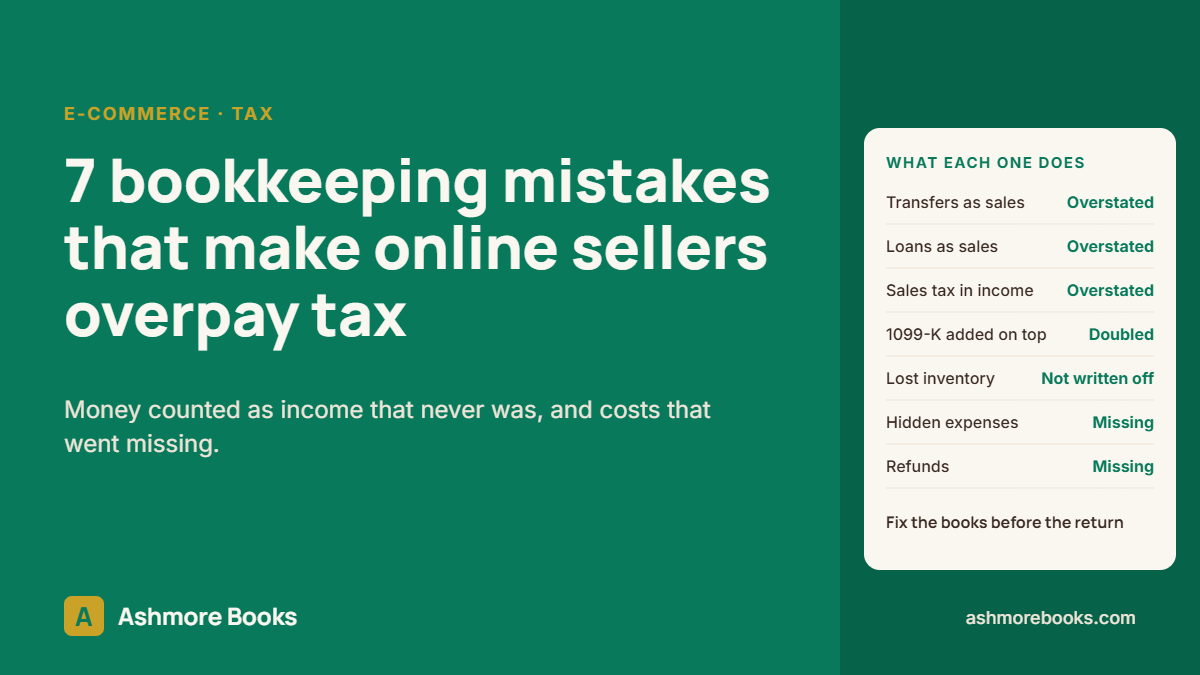
Most online sellers who overpay tax are not missing a clever strategy. Their books are counting money that was never income, or leaving out costs that were real. The return can only be as accurate as the books behind it, so every one of these mistakes flows straight into a higher tax bill. Here are the seven we see most often in e-commerce files, and how to check for each one.
In Amazon FBA sales tax nexus, we looked at which sales tax obligations Amazon handles and which it leaves with you. Sales tax is also one of the most common reasons online sellers overpay income tax, and it is one of the seven mistakes below.
1. Transfers between platforms counted as sales
Money moves from PayPal to the bank, from Stripe to the bank, from Shopify Balance to checking. If the sale was already recorded from the platform report and the deposit is categorized as income again, the same revenue is counted twice. This is most common in files where some channels use a connector and others are coded straight from the bank feed.
Check: compare income on the Profit and Loss to gross sales in each platform’s own reports. Income well above gross sales is a red flag.
2. Loan and financing proceeds booked as income
Shopify Capital, PayPal Working Capital, SBA loans, and owner contributions all arrive as deposits. When they are categorized as sales, borrowed money is taxed as profit. The repayments then often go to an expense account, which makes the picture even harder to read.
Check: look for large, round deposits in income, and for financing repayments recorded as expenses instead of against a loan balance.
3. Sales tax left inside income
Sales tax collected from customers belongs to the state. When it is recorded as part of sales and the payment to the state is not recorded as an expense or against a liability that offsets it, the tax collected stays in income and is taxed again as revenue. Marketplace facilitator tax that Amazon or Etsy collected and paid for you can cause the same problem when it is counted as sales.
Check: if you collect sales tax and there is no sales tax liability on the Balance Sheet, the tax is probably sitting in income. See Amazon FBA sales tax nexus for how marketplace tax works.
4. The 1099-K added on top of book income
A Form 1099-K reports gross payment volume, which can include sales tax, shipping, refunded orders, and sales already reported elsewhere. When the 1099-K total is added to the return on top of income from the books, instead of being reconciled to it, the same sales are taxed twice. See why a 1099-K can show more than you received.
Check: every 1099-K should tie to income in the books, with the differences listed and explained.
5. Lost, damaged, and unsellable inventory never written off
Units lost or damaged in an FBA warehouse, returned items that cannot be resold, expired stock, and products that are discontinued all still sit in the inventory balance unless someone removes them. While they stay there, their cost never reaches cost of goods sold, so profit is overstated. Amazon reimbursements for lost units should be recorded too, against the loss, not as sales.
Check: compare the inventory balance in the books to a physical count or the platform’s inventory reports at year end.
6. Real expenses that never reach the books
- Advertising, storage, and service fees deducted inside payouts, in files that record net payouts. See your books show net payouts.
- Software, samples, packaging, and ad spend paid on a personal card.
- 3PL and freight invoices paid late or by a different entity.
- Freight, duties, and tariffs left out of product cost entirely, so they are never deducted when the goods sell. See product profitability and landed cost.
Check: compare the expense accounts to the platform fee reports and to a year of personal card statements.
7. Refunds and chargebacks missing
When sales are recorded at gross from a sales report but refunds and lost chargebacks are not, income includes orders that were later given back. On products with high return rates, this alone can add up to a meaningful amount of income that was never really earned.
Check: refunds in the books should match refunds in each platform’s reports for the same period.
Why these are worth catching before the return
A missed deduction or double-counted income can sometimes be fixed by amending a return, but that costs time and fees, and an amended return is usually limited to about three years back. Finding these items while the books are being closed is cheaper and simpler. It is also the point where tax planning can still change the outcome for the current year.
Checking for these issues is built into our e-commerce accounting work, and the same team prepares the return, so nothing is lost in a handover. If you suspect your file has a few of them, request a free Books X-Ray. You get written findings and a fixed quote before anything starts.
General information, not tax advice for your situation.
Even with clean books and the right tax, many sellers still find the bank account tight. Why that happens is covered next in Profitable on paper, broke in the bank.
Frequently asked questions
Why do online sellers overpay tax?
Usually because the books count money that was never income, such as transfers, loans, sales tax, or a 1099-K added on top of book income, or because real costs like platform fees, lost inventory, and refunds never reach the books.
Is Shopify Capital taxable income?
No. The amount received is financing, not revenue, so it belongs on the Balance Sheet as a liability. Only the cost of the financing is deductible, and the rest of each repayment reduces the liability.
Do I pay income tax on the full amount on my 1099-K?
Not necessarily. The 1099-K reports gross payment volume, which can include sales tax, shipping, and refunded orders. Income on the return should come from the books, with the 1099-K reconciled to it rather than added on top.
Can I deduct inventory that was lost or damaged?
Yes. Lost, damaged, or unsellable inventory should be removed from the inventory balance and its cost recognized. Any reimbursement, such as from Amazon for lost FBA units, is recorded against that loss.
Can I fix these mistakes on a return I already filed?
Often, by amending the return, generally within three years of filing. It is simpler and cheaper to catch them while the books are being closed, before the return is prepared.
E-commerce books and tax series
Read more about e-commerce bookkeeping and tax
- Your Books Show Net Payouts. Here Is What You Are Missing.
- Why Shopify Sales Never Match Your Bank Deposits (and How the Books Should Record Them)
- How to Record Amazon Settlement Reports in QuickBooks Online
- Amazon FBA Sales Tax Nexus: What Inventory in Amazon Warehouses Means for You
- 7 Bookkeeping Mistakes That Make Online Sellers Overpay Tax (you are reading this)
- Profitable on Paper, Broke in the Bank: The E-commerce Cash Flow Trap
- Which Products Actually Make Money? Product Profitability for E-commerce Brands
Selling online and want the books done this way? See e-commerce accounting and tax.