
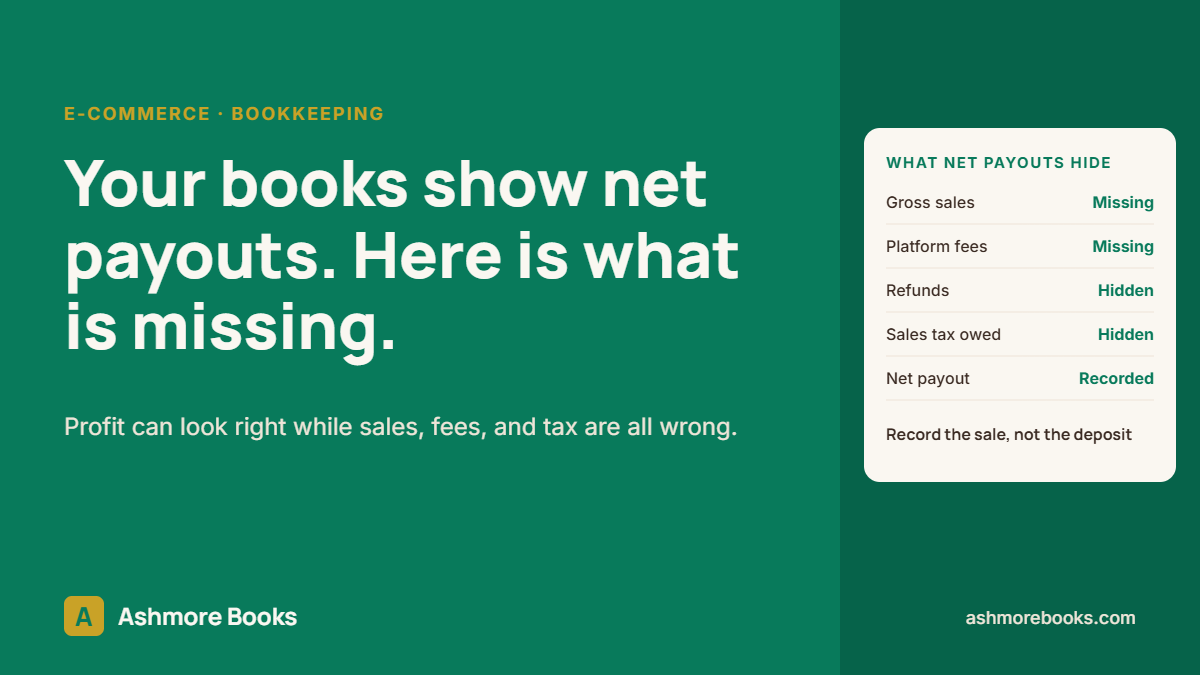
Open the Profit and Loss and compare income to what actually landed in the bank from Shopify, Amazon, Etsy, PayPal, or Stripe. If the two numbers are the same, the books are recording net payouts, not sales. It is the most common setup in e-commerce files, usually because the bank feed made it the easiest thing to do. It is also the reason a lot of online sellers do not really know how big their business is.
The short answer
A payout is what is left after the platform takes its fees, refunds, chargebacks, advertising, and holds. Booking the payout as income does not always make profit wrong, because the missing fees are missing from both sides. What it does is erase gross sales, every platform cost, refunds, and often the sales tax you owe. Those are the numbers taxes, lenders, buyers, and your own decisions depend on.
How to tell if your books record net payouts
- Income on the Profit and Loss matches total deposits from the platforms, month after month.
- There is no line for marketplace fees, payment processing, FBA fees, or refunds, or the lines are tiny.
- Sales in the books are well below the gross sales shown in Shopify or Seller Central.
- There is no clearing account for each platform on the Balance Sheet.
- The Form 1099-K totals are far higher than the income on the return, and nobody can explain the gap.
What a net-payout file is missing
| What is missing | Why it matters |
|---|---|
| Gross sales | The real size of the business. Lenders, buyers, and state sales tax thresholds all look at gross, not net. |
| Platform and payment fees | Often one of the biggest costs in the business. You cannot cut or negotiate a cost you cannot see. |
| Refunds and chargebacks | A rising return rate is an early warning on a product or supplier. Netted into payouts, it is invisible. |
| Sales tax collected | Money that belongs to the state. Left inside the payout, it sits in income and the liability disappears. |
| Advertising deducted from payouts | Ad spend charged inside a settlement never shows up as marketing cost. |
| Timing | Payouts land days after the sale, so month-end sales are reported in the wrong month. |
Why “profit is roughly right” is not good enough
- Sales tax thresholds are measured on gross sales. Economic nexus in most states starts at $100,000 of sales into the state. Books that only show net payouts cannot tell you when you cross it. See Amazon FBA sales tax nexus.
- The 1099-K reports gross. Payment platforms report gross volume to the IRS. A return built on net payouts needs a reconciliation to explain the difference, or it invites questions.
- Lenders and buyers check revenue against platform reports. If the books show a smaller business than Shopify or Seller Central does, the file loses credibility the moment someone compares them.
- Margins are impossible to measure. Without fees and refunds on their own lines, there is no way to see which products actually make money.
- Profit is not always right either. When sales tax collected stays in the payout and the remittance is recorded somewhere else, income is overstated and tax can be paid on money that was never yours.
How the fix works
- Set up a clearing account for each platform and payment processor.
- Record sales at gross from each platform’s own reports: sales, shipping, discounts, sales tax to a liability, refunds, and fees to their own expense accounts.
- Match each bank deposit to the clearing account instead of to income.
- Reconcile each clearing account monthly. It should hold only payouts still in transit and any reserve the platform is holding.
- For past periods, rebuild the months from platform reports so prior figures line up with the 1099-K and sales tax filings.
The step-by-step versions are in why Shopify sales never match your bank deposits and how to record Amazon settlement reports in QuickBooks Online.
Does fixing it change past tax returns?
Often the net profit barely moves, because the fees that were missing from expenses were also missing from income. Where it does move, the usual causes are sales tax left in income, refunds recorded twice, or deposits from loans and transfers counted as sales. Whether a past return needs attention depends on what the rebuild shows, which is why it is worth knowing before the next filing rather than after.
When it is time for help
Rebuilding a year or more of payouts across several channels is a cleanup project, and it is the kind of file our e-commerce accounting and catch-up bookkeeping work is built for. To see how far your file is from gross reporting first, request a free Books X-Ray. You get written findings and a fixed quote.
The most common version of this problem is Shopify. Next, why Shopify sales never match your bank deposits walks through every reason the payout differs from the sale.
Frequently asked questions
Is it wrong to record Shopify or Amazon payouts as income?
It is incomplete. Payouts are sales minus fees, refunds, and other deductions. Recording only the payout hides gross sales, platform costs, refunds, and sales tax, even when the bottom-line profit looks about right.
If my net profit is the same, why does gross sales matter?
State sales tax thresholds, the Form 1099-K, loan applications, and business valuations all work from gross sales. Books that show only payouts understate the business and cannot be tied to platform reports.
How do I know if my books record net payouts?
Compare income on the Profit and Loss to total platform deposits. If they match, and there are no lines for platform fees or refunds, the books are recording net payouts rather than gross sales.
Will switching to gross sales increase my taxes?
Usually not by itself, because fees are added to expenses at the same time sales are grossed up. Taxable profit changes only where something else was wrong, such as sales tax or loan proceeds sitting in income.
Can past months be rebuilt at gross?
Yes. Shopify, Amazon, Etsy, PayPal, and Stripe keep payout and settlement reports that show the gross sales and deductions behind each deposit, so prior months can be rebuilt from the platforms’ own data.
E-commerce books and tax series
Read more about e-commerce bookkeeping and tax
- Your Books Show Net Payouts. Here Is What You Are Missing. (you are reading this)
- Why Shopify Sales Never Match Your Bank Deposits (and How the Books Should Record Them)
- How to Record Amazon Settlement Reports in QuickBooks Online
- Amazon FBA Sales Tax Nexus: What Inventory in Amazon Warehouses Means for You
- 7 Bookkeeping Mistakes That Make Online Sellers Overpay Tax
- Profitable on Paper, Broke in the Bank: The E-commerce Cash Flow Trap
- Which Products Actually Make Money? Product Profitability for E-commerce Brands
Selling online and want the books done this way? See e-commerce accounting and tax.