
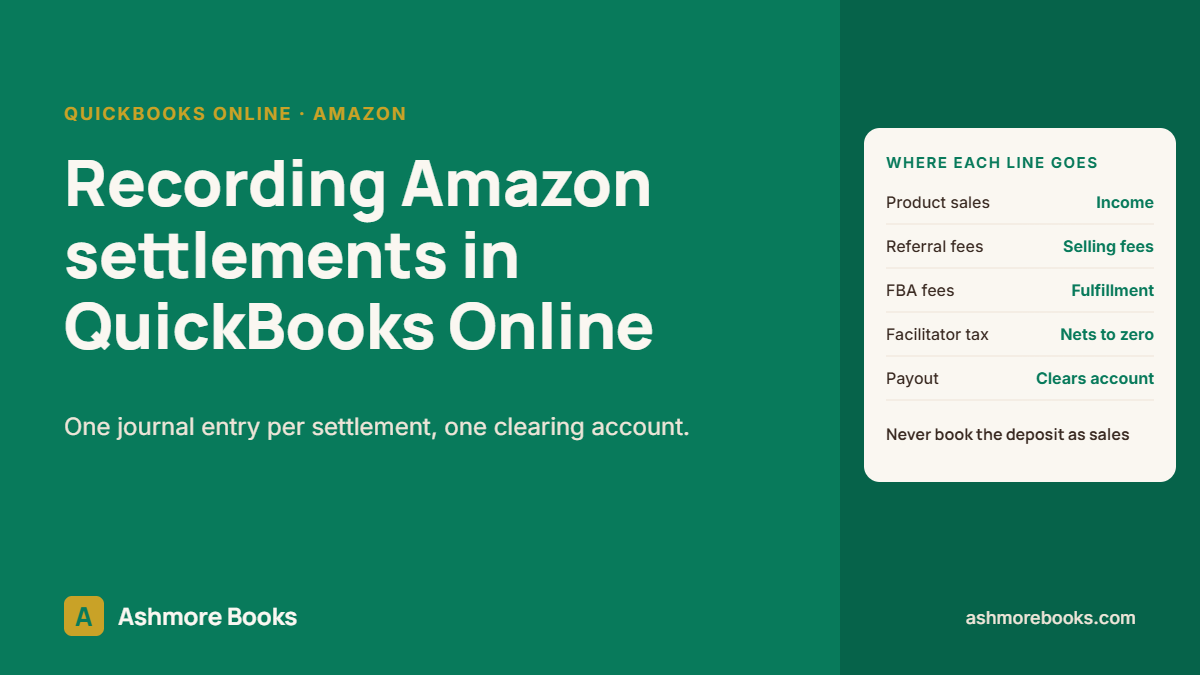
Amazon pays sellers in settlements, and each payout is the net of hundreds of sales, fees, refunds, and reimbursements. Recording the deposit as one line of income is the most common mistake in Amazon books, and it makes revenue, fees, and sales tax wrong at the same time. Here is the method that produces accurate numbers and a clean reconciliation.
In why Shopify sales never match your bank deposits, we set up the clearing account method for Shopify payouts. Amazon uses the same idea, but each settlement carries far more lines, so it needs its own walkthrough.
The short answer
Record each settlement as one summary journal entry into an Amazon clearing account. Gross product sales and shipping go to income, Amazon fees go to their own expense accounts, refunds reduce sales, reimbursements are recorded separately, and marketplace facilitator tax goes in and out so it nets to zero. The bank deposit then clears the account.
What is inside a settlement report
| Settlement line | What it is | Where it belongs |
|---|---|---|
| Product sales | Gross price of items sold | Sales income |
| Shipping and gift wrap credits | Paid by buyers | Shipping income or sales |
| Promotional rebates | Discounts you funded | Discounts (reduces sales) |
| Marketplace facilitator tax | Tax Amazon collected and paid to the state | In and out, nets to zero |
| Referral fees | Amazon’s commission on each sale | Amazon selling fees |
| FBA fulfillment fees | Pick, pack, and ship per unit | Fulfillment fees |
| Storage and other FBA fees | Monthly, long-term, inbound placement | FBA storage and service fees |
| Advertising (if charged here) | Sponsored ads deducted from the payout | Advertising |
| Refunds | Reversed sales, less a fee Amazon keeps | Reduces sales; fee refund reduces fees |
| Reimbursements | Lost or damaged FBA inventory | Inventory loss recovery |
| Reserve | Funds Amazon holds back | Stays in clearing or a reserve account |
The recording method, step by step
- Set up the accounts once. Amazon Clearing (current asset), Amazon Sales, Shipping Income, Promotional Discounts, Amazon Selling Fees, FBA Fulfillment Fees, FBA Storage Fees, Advertising, and Inventory Reimbursements. Keeping fees in separate accounts is what later makes margin analysis possible.
- Download each settlement from the Payments section of Seller Central.
- Post one journal entry per settlement. Credit sales and shipping, debit discounts, fees, and refunds, record facilitator tax in and out, and let the net land in Amazon Clearing. That net should equal the settlement total.
- Match the deposit as a transfer from Amazon Clearing, never as income.
- Handle month end consistently. Settlements rarely end on the last day of the month. Either record each settlement by its end date every time, or split the settlement at month end for accurate monthly revenue. Higher-volume sellers usually need the split.
- Record cost of goods sold separately. Settlement reports do not carry product cost. COGS comes from units sold at landed cost, or from inventory counts.
- Reconcile Amazon Clearing every month. The balance should equal payouts in transit plus any reserve Amazon is holding.
Common mistakes that overstate or hide the numbers
- The deposit booked as income, so revenue is understated and fees never appear.
- Marketplace facilitator tax posted as income and again as an expense, which inflates both sides of the Profit and Loss.
- Every fee lumped into one “Amazon fees” account, so nobody can see what fulfillment or storage really costs.
- Advertising recorded twice: once when deducted from the settlement and again from the credit card statement.
- Reimbursements for lost inventory recorded as sales.
- A negative settlement, where fees exceeded sales and Amazon charged the card on file, recorded as a random card expense.
By hand or with a connector?
At lower volume, one journal entry per settlement is quick to post by hand. With higher volume or several marketplaces, connector apps such as A2X or Link My Books post the same entries automatically. Either way the account mapping decides whether the numbers are right, so it deserves a review before you trust the output.
If your Amazon income has been booked from deposits, the past settlements can be rebuilt from Seller Central data. That is a common part of our catch-up bookkeeping and e-commerce accounting work. For how Amazon sales tax interacts with inventory in other states, see Amazon FBA sales tax nexus. To find out what is wrong in your file first, request a free Books X-Ray.
One line in every settlement, marketplace facilitator tax, raises a bigger question about where you owe sales tax. That is the subject of Amazon FBA sales tax nexus.
Frequently asked questions
How do I record Amazon deposits in QuickBooks Online?
Record each settlement as a summary journal entry into an Amazon clearing account, with gross sales as income and fees, refunds, and adjustments on their own lines. Then match the bank deposit as a transfer from the clearing account, not as income.
Is Amazon marketplace facilitator tax income?
No. It is tax Amazon collected from the buyer and paid to the state on your behalf. It appears in the settlement as money in and money out, so it should net to zero and never touch income or expense.
How often does Amazon pay sellers?
Standard settlement periods run about 14 days, and eligible sellers can request payouts more often. Either way, settlement dates rarely line up with month end, so the books need a consistent rule for the settlement that spans two months.
Why does my Amazon clearing account have a balance?
Some balance is normal: payouts in transit at month end and funds Amazon holds as a reserve. A balance that grows every month usually means a settlement was missed or recorded twice, or a deposit was booked to income instead of clearing.
Do I need A2X or Link My Books?
Not at low volume, where one entry per settlement can be posted by hand. At higher volume or with several marketplaces, a connector saves time and reduces errors, but it still needs correct account mapping and a monthly clearing review.
E-commerce books and tax series
Read more about e-commerce bookkeeping and tax
- Your Books Show Net Payouts. Here Is What You Are Missing.
- Why Shopify Sales Never Match Your Bank Deposits (and How the Books Should Record Them)
- How to Record Amazon Settlement Reports in QuickBooks Online (you are reading this)
- Amazon FBA Sales Tax Nexus: What Inventory in Amazon Warehouses Means for You
- 7 Bookkeeping Mistakes That Make Online Sellers Overpay Tax
- Profitable on Paper, Broke in the Bank: The E-commerce Cash Flow Trap
- Which Products Actually Make Money? Product Profitability for E-commerce Brands
Selling online and want the books done this way? See e-commerce accounting and tax.