
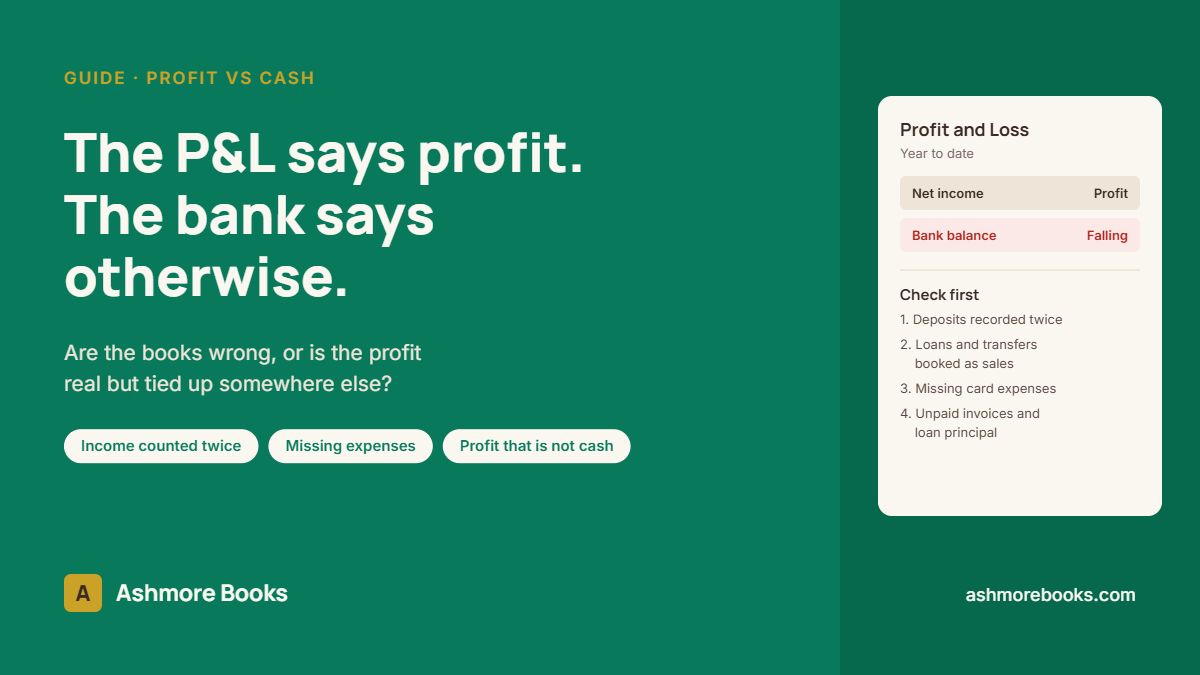
When the Profit and Loss says the business made money but the bank account says otherwise, one of two things is true. Either the books are wrong, and income is overstated or expenses are missing. Or the books are right, and the profit is real but tied up somewhere that is not cash. The fix for each is completely different, so the first job is working out which one you have.
Quick check: which problem do you have?
- The books are probably wrong if profit is higher than your deposits minus your spending for the same period, and the Balance Sheet shows no large unpaid customer balances, inventory build-up, equipment purchases, or loan payments. Start with the first two sections below.
- The profit may be real if the Balance Sheet shows growing Accounts Receivable, inventory, equipment, or loan payments. Start with the third section.
- If both are true, which is common, fix the first two sections before trusting the third.
When the books are wrong: income that is not really income
1. Deposits recorded twice
A payment is received against an invoice, and then the bank deposit is added from the bank feed as a new sale instead of being matched to that payment. The same sale is counted twice. The usual sign is a large or growing Undeposited Funds balance. Here is how to find and clear it.
2. Transfers, loans, and owner money booked as sales
Money moved from savings, a loan or line of credit draw, a PPP or EIDL deposit, or cash the owner put in is not revenue. When the bank feed categorizes these deposits as income, profit rises by the full amount. They belong on the Balance Sheet as transfers, loan balances, or owner contributions.
3. Sales tax and gross platform payouts
Sales tax collected is owed to the state, so it is a liability, not income. On platforms like Shopify, Amazon, Stripe, or Square, recording the gross sale but never recording the fees, refunds, and chargebacks that came out of it overstates profit.
4. Customer payments with no invoice behind them
On a cash basis report, customer money that is not linked to an invoice shows as Unapplied Cash Payment Income. Sometimes it is real income. Often it is a payment that was never applied, or a deposit that was also recorded separately as a sale. Here is what it means and how to clear it.
When the books are wrong: expenses that are missing
- A credit card that is not connected to QuickBooks, so a whole card of spending never reaches the P&L.
- Business costs paid from a personal card or personal account and never recorded.
- Payroll recorded at net pay only, so employer taxes, withholdings, and benefits are missing.
- Expenses posted to the Balance Sheet by mistake, for example to a loan, a clearing account, or Opening Balance Equity, instead of to an expense account.
- Transactions still sitting in the bank feed For Review tab. Until they are added, they are not in the books at all.
A file can be reconciled to the bank every month and still have every one of these problems, because reconciliation checks that the cash is complete, not that each item is in the right account. More on why reconciled books can still be wrong.
When the books are right: profit that is not cash
Profit and cash are measured differently. The items below are correct accounting, and they still leave the bank lower than the P&L suggests.
- Customers who have not paid. On an accrual P&L, a sale counts when it is invoiced. If Accounts Receivable is growing, part of the profit is sitting in unpaid invoices.
- Inventory bought but not sold yet. Inventory is an asset until it sells, so a large purchase reduces cash now and reaches the P&L later as cost of goods sold.
- Loan principal. Only the interest is an expense. The principal part of each payment reduces the loan balance and never appears on the P&L.
- Equipment and vehicles. A large purchase is recorded as an asset and expensed over time through depreciation.
- Owner draws and distributions. Money the owner takes out is not a business expense, so it lowers cash without lowering profit.
- Owner income tax paid from the business account. For an LLC or S corporation, estimated tax paid for the owner is recorded as a draw or distribution, not an expense.
A 20-minute self-check in QuickBooks Online
- Run a Profit and Loss and a Balance Sheet for the same period, on the same basis (cash or accrual).
- Open each income account and sort by amount. Look for round numbers, transfers, loan proceeds, and deposits from your own accounts.
- On the Balance Sheet, check Undeposited Funds (Payments to deposit). A large or growing balance points to double-counted income.
- Compare Accounts Receivable to the customers who actually owe you money.
- Compare each credit card balance to the card statement. A missing card, or a balance that never changes, means missing expenses.
- Check the bank feed For Review tab for anything not yet added.
- Compare loan balances to lender statements, and look at Opening Balance Equity, which should be zero once the books are set up correctly.
If the answers point to the first two groups, the books need correcting before the numbers are used for decisions or taxes. If they point to the third, the books may be fine, and the question becomes cash planning.
When to hand it off
- The gap between profit and cash is large and you cannot explain it from the lists above.
- The problems go back more than a few months, or into a year that has already been filed.
- A lender, buyer, or tax preparer is about to rely on the numbers.
- You fix it and the same problem comes back the next month.
Correcting income and expenses that have drifted for months is routine QuickBooks cleanup work. If the books are right and you want someone to walk you through what they say, that is a financial review. Not sure which one you need? Request a free Books X-Ray. The file is reviewed read-only and you get written findings and a fixed quote.
Frequently asked questions
Why does my P&L show a profit when there is no money in the bank?
Either the books are overstating profit, usually through income recorded twice, transfers or loans booked as sales, or missing expenses, or the profit is real but tied up in unpaid invoices, inventory, loan principal, equipment, or owner draws. The Balance Sheet shows which one it is.
Can QuickBooks count the same income twice?
Yes. The most common cause is a customer payment received against an invoice, and then the bank deposit also added as a new sale instead of being matched to that payment. A growing Undeposited Funds balance is the usual sign.
Why are loan payments not on my Profit and Loss?
Only the interest part of a loan payment is an expense. The principal reduces the loan balance on the Balance Sheet. That is correct accounting, and it is one reason cash can be lower than profit.
Is money I put into the business counted as income?
No. Owner contributions, loan proceeds, and transfers between your own accounts are not revenue. They belong on the Balance Sheet. If the bank feed recorded them as sales, profit is overstated by that amount.
My books are reconciled. Can the P&L still be wrong?
Yes. Reconciliation confirms every bank transaction is recorded. It does not confirm each one is in the right account, so income can still be double counted or expenses misclassified in a fully reconciled file.