
The Profit and Loss says the store made money last year. The bank account says there is barely enough to cover the next inventory order. For e-commerce brands this is one of the most common and most stressful gaps in the numbers, and it usually has nothing to do with sales. The profit is real. It is just sitting somewhere other than the bank.
In 7 bookkeeping mistakes that make online sellers overpay tax, we covered errors that make profit look bigger than it is. This article assumes the profit is real and asks a different question: where did the cash go?
The short answer
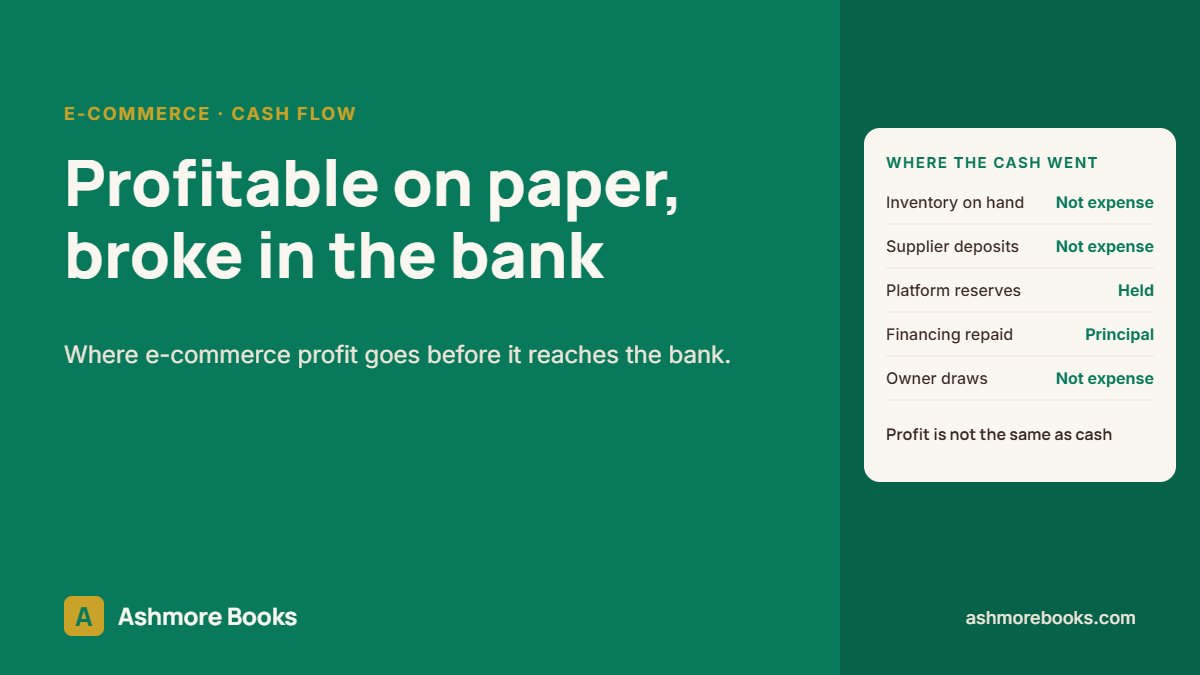
Profit measures what the business earned. Cash measures what it has. In e-commerce the two drift apart because of inventory bought before it sells, deposits paid to suppliers, money held back by platforms, financing repaid out of payouts, sales tax waiting to be paid, and owner draws. None of those appear as expenses on the Profit and Loss, but every one of them takes cash.
First, rule out bad books. If income is overstated or expenses are missing, the profit itself is wrong, and that is a different problem. See P&L shows profit but losing money and your books show net payouts.
Six places e-commerce cash disappears
- Inventory on the shelf. Products bought but not yet sold are an asset, not an expense. A brand that orders six months of stock ahead of the fourth quarter can show a healthy profit while most of its cash sits in a warehouse.
- Deposits paid to suppliers. Manufacturers often take 30% to 50% up front, months before the goods arrive. That cash is gone, and nothing reaches cost of goods sold until the units sell.
- Platform reserves and payouts in transit. Amazon and Shopify can hold back part of a payout, and orders from the last days of the month are paid out next month. The income is booked; the cash has not arrived.
- Financing repaid out of payouts. Shopify Capital, PayPal Working Capital, and similar products are often repaid automatically as a share of each payout. Only the financing cost is an expense. The rest of each repayment is principal, so the payout shrinks but the profit does not.
- Sales tax collected but not yet paid. Tax collected from customers sits in the bank until the filing date. It looks like cash you have, but it belongs to the state.
- Owner draws and income tax. Money taken out by the owner, and income tax paid on last year’s profit, never touch the Profit and Loss of the business.
Growth makes it worse, not better
In most product businesses, cash goes out before it comes back. You pay the supplier, wait for production and freight, wait for the goods to sell, and then wait for the payout. The faster sales grow, the more inventory has to be bought ahead, so a brand can grow its way into a cash shortage while every month shows a profit. That is also why the January after a strong fourth quarter is often the tightest month of the year.
A simple example
The figures below are illustrative, not client figures.
| Item | Effect on profit | Effect on cash |
|---|---|---|
| Net profit for the year | $120,000 | $120,000 |
| Inventory increased by $70,000 | None | ($70,000) |
| Supplier deposits for next season | None | ($25,000) |
| Financing principal repaid from payouts | None | ($30,000) |
| Owner draws | None | ($40,000) |
| Change in cash | ($45,000) |
A year with a $120,000 profit ends with $45,000 less in the bank than it started with. Nothing is wrong with the books. The profit went into inventory, deposits, debt, and the owner.
How to see it in your own numbers
- Statement of Cash Flows. QuickBooks Online produces one, and it shows exactly where profit turned into something other than cash. It is only reliable if inventory, loans, and clearing accounts are recorded correctly.
- Balance Sheet, month over month. Watch inventory, supplier deposits, platform clearing accounts, and loan balances. Growth in any of them is cash leaving the bank.
- A 13-week cash forecast. Expected payouts in, and supplier payments, ad spend, financing, sales tax, and payroll out, week by week. This is where an inventory order gets tested before it is placed.
What to do about it
- Plan large inventory orders against the forecast, not against last month’s profit.
- Use product profitability to put inventory cash behind the products that actually make money.
- Negotiate supplier terms, or split orders, to shrink the gap between paying and getting paid.
- Set aside sales tax and income tax in a separate account as it is collected or earned.
- Read financing offers by their total cost and the share of each payout they take, not just the headline amount.
A monthly Statement of Cash Flows and a rolling cash forecast are part of what our CFO services deliver for e-commerce brands, and our financial review walks owners through what the numbers mean. It all starts with clean books through e-commerce accounting. To find out where your cash is going, request a free Books X-Ray.
Putting inventory cash behind the right products is the last piece. Which products actually make money? shows how to measure it, product by product and channel by channel.
Frequently asked questions
Why is my online store profitable but I have no cash?
Profit is not cash. In e-commerce the gap usually comes from inventory still on hand, deposits paid to suppliers, platform reserves, financing repaid out of payouts, sales tax waiting to be paid, and owner draws. None of these are expenses, but all of them use cash.
Is inventory an expense when I buy it?
No. Inventory is an asset until it sells. Its cost moves to cost of goods sold as units are sold, so a large purchase reduces cash immediately but reduces profit only over time.
How do I record Shopify Capital repayments?
Record the amount received as a liability. Each automatic deduction from a payout is split between repaying that liability and the cost of the financing. Only the financing cost is an expense.
Why is cash tighter when sales are growing?
Inventory has to be bought before it sells, and the supplier is usually paid before the platform pays you. The faster sales grow, the more cash is tied up in stock and deposits at any given time.
What report shows where my profit went?
The Statement of Cash Flows. It starts with net profit and shows the changes in inventory, receivables, loans, and owner draws that explain the difference between profit and the change in cash.
E-commerce books and tax series
Read more about e-commerce bookkeeping and tax
- Your Books Show Net Payouts. Here Is What You Are Missing.
- Why Shopify Sales Never Match Your Bank Deposits (and How the Books Should Record Them)
- How to Record Amazon Settlement Reports in QuickBooks Online
- Amazon FBA Sales Tax Nexus: What Inventory in Amazon Warehouses Means for You
- 7 Bookkeeping Mistakes That Make Online Sellers Overpay Tax
- Profitable on Paper, Broke in the Bank: The E-commerce Cash Flow Trap (you are reading this)
- Which Products Actually Make Money? Product Profitability for E-commerce Brands
Selling online and want the books done this way? See e-commerce accounting and tax.